What is a good SAT score?
What is a good SAT score? If you're looking at your SAT score of 1300, you might not know whether to celebrate or schedule a retake.
The national average SAT score is 1029. But that number means almost nothing without context.
Good isn't a universal label. It's a match between your child's score and the expectations of the colleges on their list.
A 1300 can be excellent for one student and disappointing for another. A student applying to state honors programs might be thrilled. A student aiming for MIT might need to keep going. That gap creates stress, and stress leads to bad decisions like retaking without a plan or skipping the test entirely.
At NAT, 92% of our students improve by 2 grade letters or 90+ SAT points. We've learned that the best score is the one paired with a clear strategy. This guide breaks down percentiles, college benchmarks, and section targets. It also introduces the framework our tutors use to set realistic goals from real session data.
What is a good SAT score?
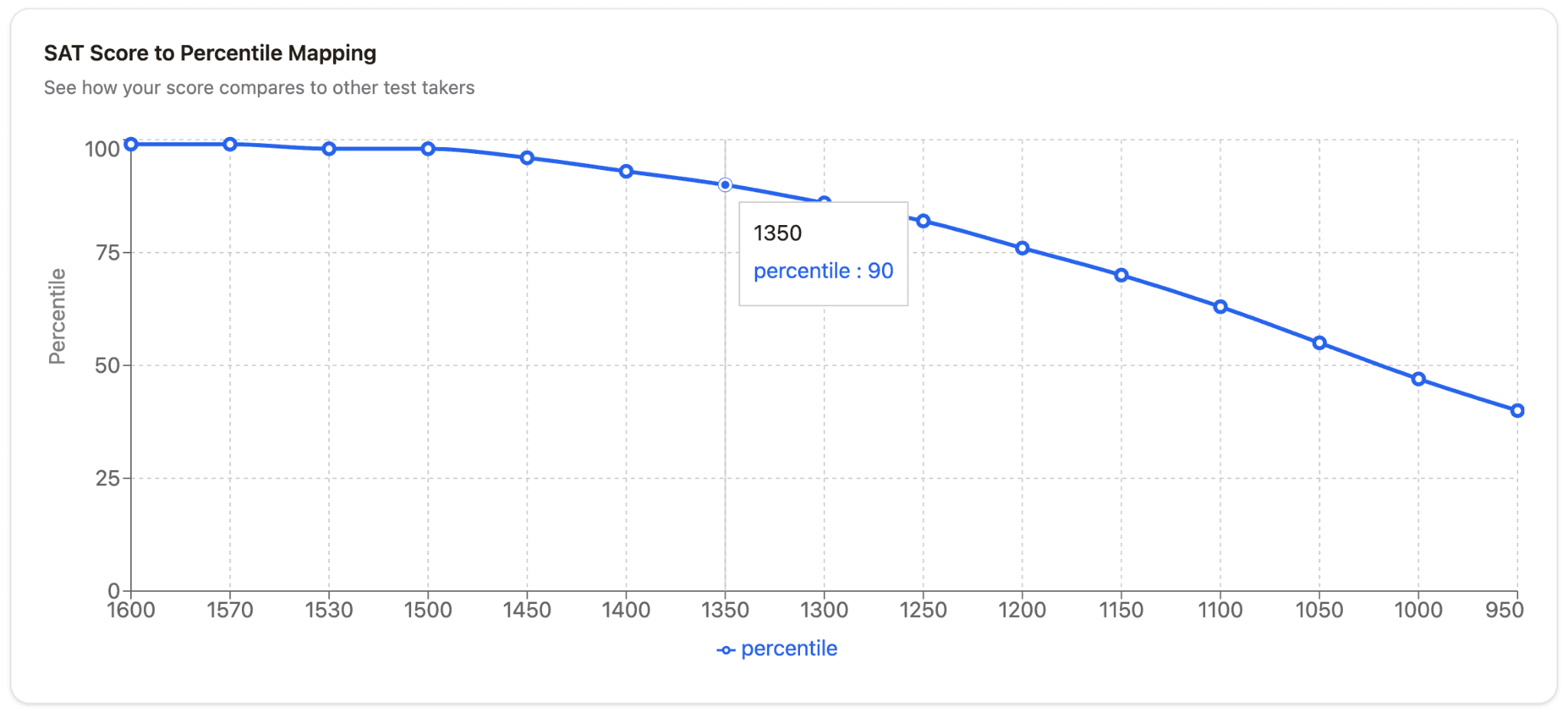
A good SAT score is any score that meets or exceeds the middle 50% range of your target colleges. Nationally, anything above the average SAT score of 1029 is above average, 1350 places you in the top 10%, and 1500+ puts you in elite territory. The only definition that matters is whether your score strengthens your specific application.
The College Board reports that the class of 2025 earned a mean total score of 1029. That breaks down to 521 in Reading and Writing and 508 in Math. Yet those averages hide a wide spread. A score of 1190 hits the 75th percentile, meaning your child outperformed three out of four test takers.
At 1350, you're in the 90th percentile. At 1530, you're in the 99th. Percentiles are useful for context, but colleges care about fit. A 1350 is competitive at many selective state schools. That same 1350 falls below the typical range at MIT, where the middle 50% of admitted students score between 1510 and 1580. Always check your target school's published ranges before you label a score good or bad. See the screenshot below from North American Tutor’s data to cross-check your number with the percentile mapping if your score is 1350:
How is the SAT scored in 2026?
The SAT runs on a 400 to 1600 scale. Your total is the sum of two sections: Reading and Writing (200 to 800) and Math (200 to 800). The digital SAT format is adaptive, meaning your performance on Module 1 determines the difficulty of Module 2. Two students can miss the same number of questions and receive different scores.
The College Board uses equating to ensure that a 1300 means the same thing regardless of which test date your child takes. Each section contains two modules. The first mixes easy, medium, and hard questions. If your child performs well, Module 2 serves harder questions that unlock higher score ceilings.
Understanding this structure matters. A careless error in Module 1 can lock your child into the easier Module 2 path and cap their total score before the second half even begins.
If you took the PSAT, your score is already a useful early baseline. Our PSAT to SAT score conversion guide shows exactly how those two scores relate and what a realistic SAT target looks like from there.
What is a good SAT score by college type?
Here's how score expectations break down across selectivity tiers:
Selectivity Tier | Examples | Typical Middle 50% |
|---|---|---|
Highly selective | MIT, Harvard, Stanford | 1500 to 1580 |
Very selective | UCLA, Georgetown | 1380 to 1530 |
Selective | Boston University, UMich | 1250 to 1450 |
Moderately selective | Many state schools | 1100 to 1300 |
See the screenshot below from North American Tutor’s data to compare your score to your desired college:
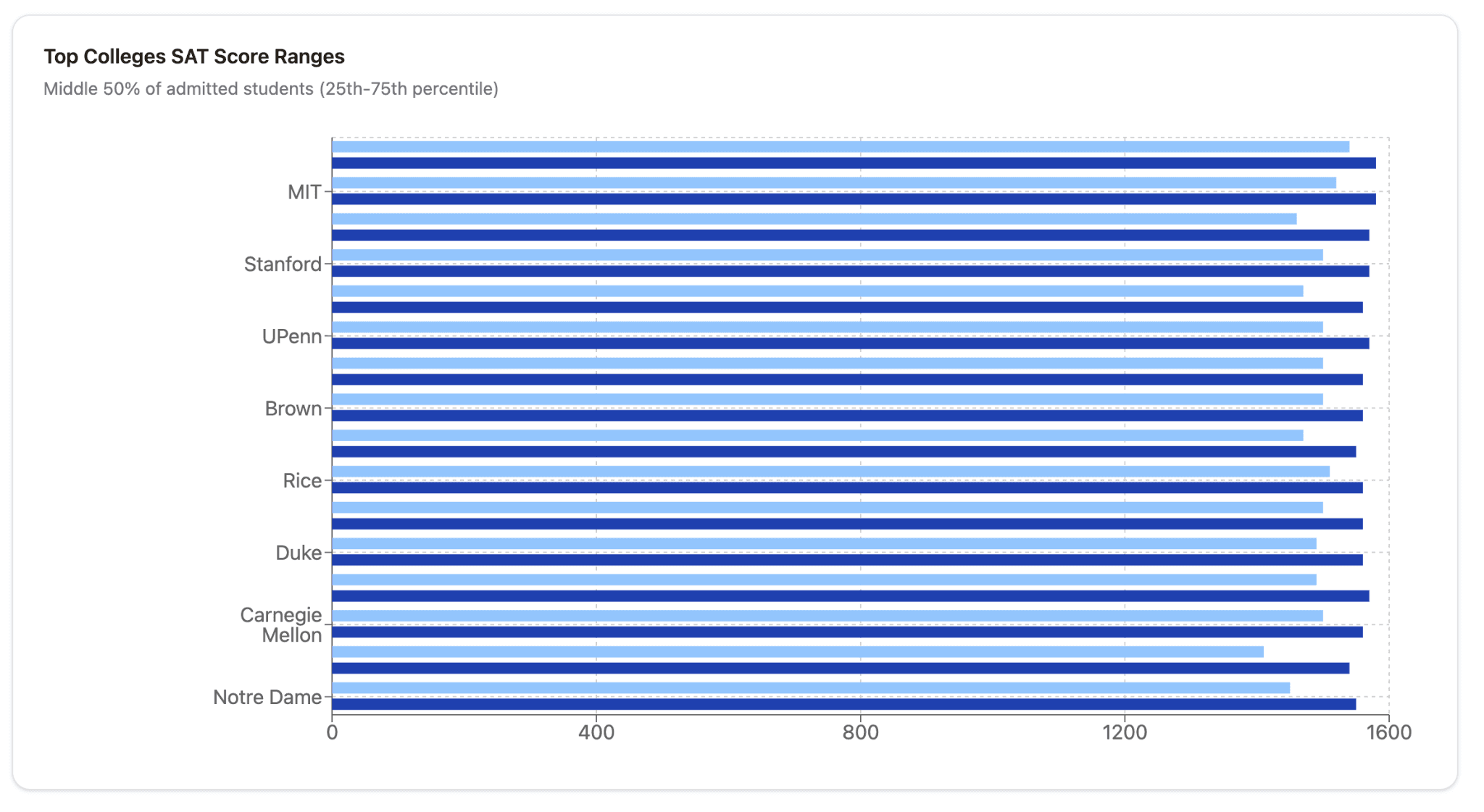
Scholarship thresholds follow a similar pattern. Most merit-based full-ride programs look for 1400 to 1500+. Standard merit scholarships typically start around 1200 to 1350, depending on the institution.
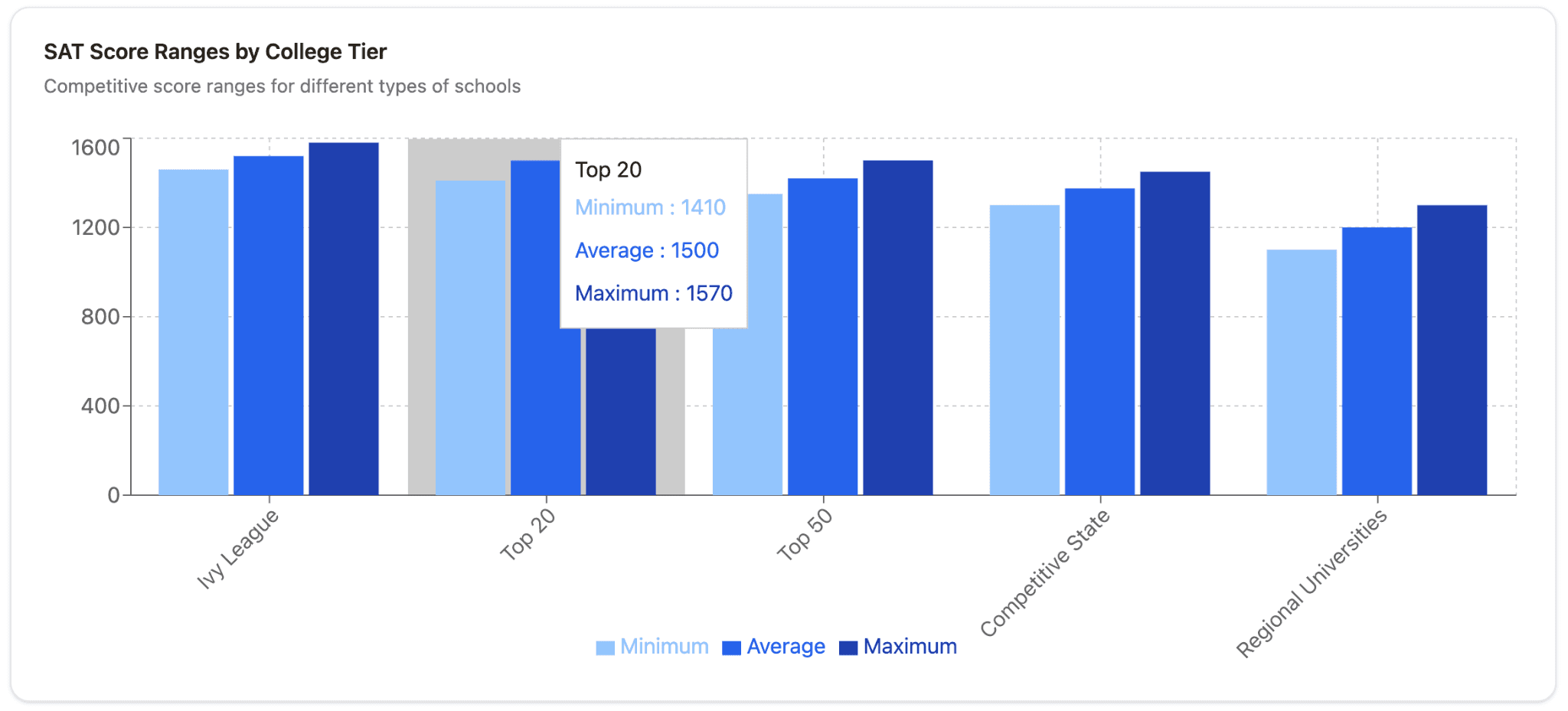
Our SAT tutors make a comprehensive dataset for the college SAT Score Ranges by College Tier, showing the competitive score ranges for different types of schools
Ivy League — Score Range: 1460 - 1580 (Average: 1520)
Top 20: Score Range — 1410 - 1570 (Average: 1500)
Top 50 Score Range — 1350 - 1500 (Average: 1420)
Competitive State — Score Range: 1300 - 1450 (Average: 1375)
Regional Universities — Score Range: 1100 - 1300 (Average: 1200)
Our SAT and ACT tutor, Uju Kim, who scored 1590 on the SAT and 35 on the ACT at Northwestern, targeting top-20 schools, explains to us after having 150+ student sessions:
This distinction matters more than any score benchmark. A student with content gaps needs targeted drills. A student with psychology gaps needs timed practice and confidence work. At NAT, we diagnose this in the first session, so we don't spend weeks solving the wrong problem. Your college list should determine your target score, but your diagnostic profile should determine your prep plan.
The North American Tutors’ Score Target Matrix: How tutors set realistic goals
After ten thousand hours of one-on-one SAT sessions, NAT tutors noticed a pattern that contradicts conventional wisdom. Students who start at 1100 to 1200 often improve 120 to 150 points in 8 to 10 weeks. Students who start at 1300 to 1400 typically improve only 60 to 80 points in the same timeframe.
The lower starters have content gaps, which are straightforward to identify and fix. The higher starters have strategy and psychology gaps, which take longer to rewire. We call this the NAT Score Target Matrix.
It sorts students into four diagnostic profiles:
Profile | Starting Score | What's Holding Them Back | Realistic Gain (8 to 10 weeks) |
|---|---|---|---|
Beginning Builder | Below 1000 | Foundational skill gaps | 80 to 120 points |
Solid Foundation | 1000 to 1190 | Content review needed | 100 to 150 points |
High Achiever | 1200 to 1390 | Precision tuning | 60 to 100 points |
Elite Pusher | 1400+ | Strategy, timing, error analysis | 40 to 80 points |
The Matrix also includes a 3-question retake decision test our tutors use to determine whether another attempt is worth your child's time:
Is your score within 50 points of your target school's middle 50%?
Did you underperform your diagnostic average by more than 30 points on test day?
Do you have at least 6 weeks to prep before the next test date?
If you answer yes to at least two of those, a retake is likely worth it.
This framework only works because it comes from real session data, not generic percentile tables. If you want to see how it applies to your child, start with a diagnostic and a clear target. Our guide on SAT practice tests explains how to build a reliable baseline before you commit to a test date.
Is 1300 a good SAT score? Is 1400? Is 1500?
A 1300 SAT score is good for moderately selective schools and lands in the top 18% nationally. A 1400 SAT score is strong for selective schools and sits in the top 8%. A 1500 SAT score is excellent and competitive at all but the most selective Ivy League programs. Always compare these numbers to your target school's middle 50% range before deciding to retake.
If you're weighing the SAT against the ACT, our SAT to ACT conversion chart puts these numbers in direct perspective. A 1300 equates to roughly a 28 on the ACT. A 1400 equates to roughly a 30. A 1500 equates to roughly a 34. These equivalents help confirm which test plays to your child's strengths before you commit to either.
Elizabeth G. improved from 1370 to 1480 in three sessions with a NAT tutor. Her tutor targeted subject-modifier placement and semicolon rules in the Reading and Writing section, which recovered the exact points she'd been losing on every practice test. That kind of precision only happens when you know which profile your child actually fits. Read the success story of Elizabeth with her own.
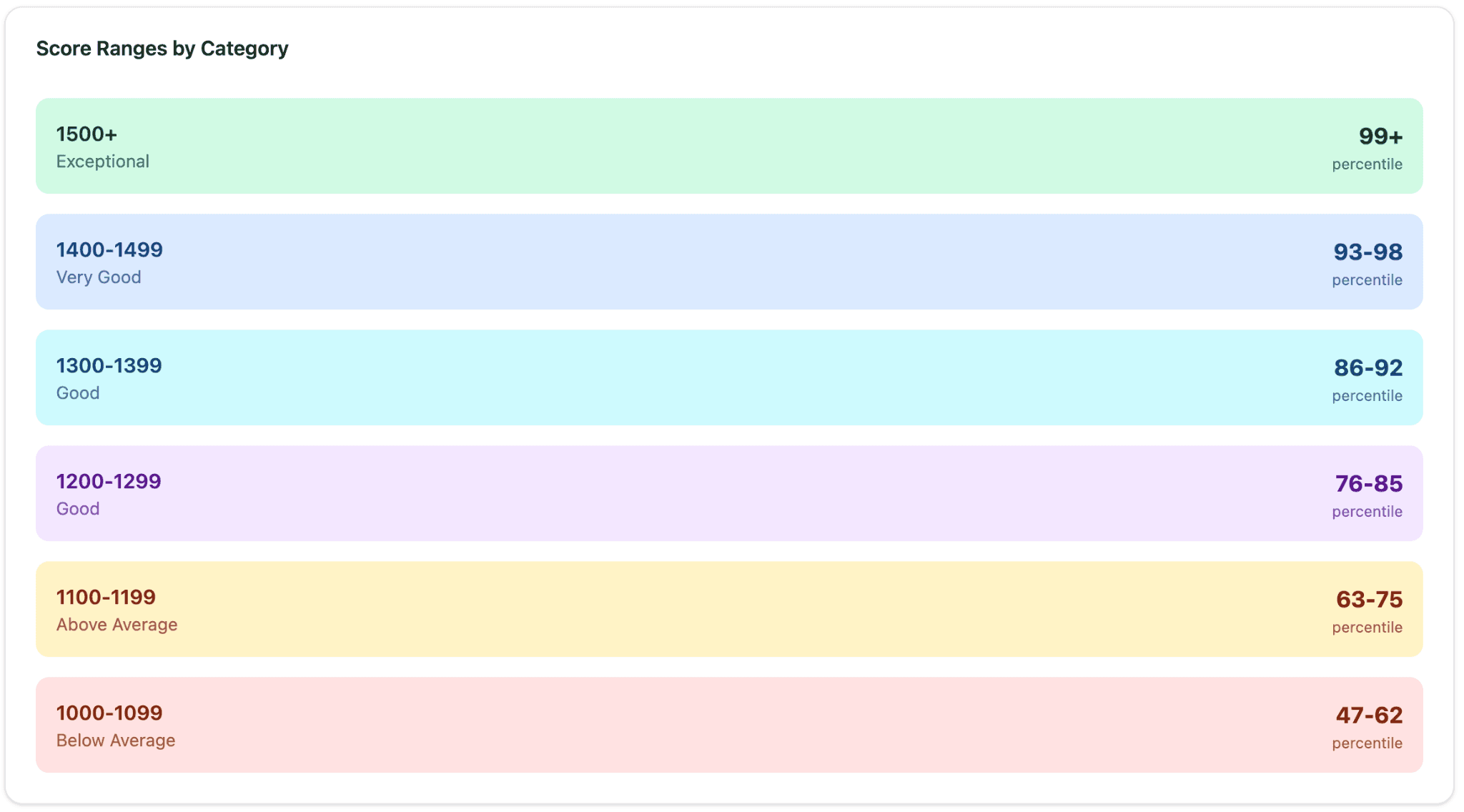
Our SAT tutors made the chart below to show students a quick score range by category. Compare your SAT score with the chart below:
Conclusion
A good SAT score isn't a trophy. It's a tool that opens specific doors.
The right target depends on your college list, your child's starting diagnostic, and your available timeline. Start with your target school's middle 50% range. Use the NAT Score Target Matrix to identify which prep profile fits. Then build the plan around your child's actual gaps, not generic worksheets.
If you want to know exactly where your child stands, our one-on-one SAT tutoring pairs students with tutors who've scored in the top 1%. We build a custom plan from the first session, not the third week.
Schedule your free consultation today. Your grades are now our responsibility.