SAT to ACT Conversion Chart | Compare and Choose Your Test
Introduction
If you're grinding through SAT prep and stuck at 1300, you might be wondering what that score looks like on the ACT. You're not alone. The SAT to ACT conversion question comes up constantly, from students who've hit a score plateau to parents who found three different charts online and got three different answers.
Here's the truth: the confusion is real, but it's fixable. The official concordance tables published by the College Board and ACT, Inc. give you exact equivalents for every score from 1000 to 1600. What no chart tells you is what to do with that number once you have it. That's where most students make a costly mistake.
This guide gives you the exact conversion numbers you need. It also gives you something more valuable: the strategic context that turns a lookup table into a real plan. Whether you're deciding if the ACT is worth it, checking your middle-50 range for a target school, or just tired from SAT prep and wondering if there's a better path, you'll find your answer here.
If your student is already working with a one-on-one SAT tutoring specialist, they may have already raised this exact question. This post is the resource we point them to.
What Is a 1300 SAT on the ACT?
A 1300 SAT is equivalent to a 28 ACT, according to the official College Board and ACT, Inc. concordance tables. A 28 places a student in roughly the top 10% of ACT test-takers nationally, a score that opens the door to competitive universities while still leaving real room to grow.
Students in the 1300 range ask this question more than any other score group, and for understandable reasons. It sits at a threshold where switching tests feels tempting. The conversion number alone, though, doesn't tell you whether you'd actually score a 28 on the ACT if you sat for it tomorrow.
Aryan Waghmode, 100th-percentile MCAT scorer, Johns Hopkins Neuroscience, who tutors students targeting 1350–1500 on the SAT, explains the skill gap:
Many students at this score range are dealing with a content plateau, not a format plateau. Understanding which one you're facing changes everything. If you're also researching how your score stacks up nationally, our guide on what is a good SAT score gives the full context on what 1300 means across different college tiers.
What Is a 1400 SAT on the ACT?
A 1400 SAT converts to a 31 ACT on the official concordance scale. At this level, students enter genuinely competitive territory. A 31 ACT is the threshold where selective colleges take notice, and it's the range where merit scholarship eligibility opens up at many strong regional universities.
This is also where the stakes of test choice become significant. A 31 ACT isn't handed to you just because you're scoring 1400 on the SAT. It has to be earned on a different test, with different timing, a different section structure, and a Science section that doesn't exist on the SAT at all.
92% of NAT students improved by 2 grade letters or 90+ SAT points. Students who invest in structured SAT tutoring packages at this score level typically see the fastest efficiency gains because their foundational skills are solid and targeted instruction can close specific gaps quickly.
If you're at 1400 and researching Ivy League targets, check the exact score ranges in our Ivy League SAT requirements guide. Knowing the middle-50 at your target schools is more useful than a converted number on its own.
What Is a 1500 SAT on the ACT?
A 1500 SAT is equivalent to a 34 ACT. That places a student in the top 1–2% of all test-takers nationally. At this range, scores are competitive at every Ivy League school and near-peer institution. The strategic question shifts from "how do I reach this score?" to "is it worth retaking at all?"
At the 1500+ range, the conversion table is most useful for college research, not test selection. Understanding what the highest possible score looks like in context can also help here — our post on the highest SAT score covers the diminishing returns question in depth.
Complete SAT to ACT Conversion Table (1000–1600)
The table below is based on the official College Board concordance tables and the ACT official SAT/ACT concordance. These tables were built from a 2017 study of 589,753 students who took both tests. The College Board has confirmed that existing concordance tables remain valid for digital SAT scores.
SAT Score | ACT Equivalent | College Positioning |
1600 | 36 | Perfect score on both scales |
1550 | 35 | Top 1% nationally |
1500 | 34 | Ivy League competitive |
1450 | 33 | Highly selective threshold |
1400 | 31 | Selective college range |
1350 | 30 | Strong competitive score |
1300 | 28 | Top 10% nationally |
1250 | 27 | Above national average |
1200 | 25 | Solid mid-range score |
1150 | 23 | National average range |
1100 | 22 | Room to grow |
1050 | 20 | Below average nationally |
1000 | 19 | Significant improvement recommended |
Highlighted rows reflect the most-searched score equivalents.
For context on where the national average sits, our average SAT score guide shows how these numbers compare to what most students actually score. If you want to see how scores break down by geography, the average SAT score by state breakdown from the Class of 2025 data is also worth reviewing before you finalize a target.

If you started with an ACT score and want the reverse lookup, see our ACT to SAT score conversion guide.
Section-by-Section Conversion: Math and Reading and Writing
Composite score conversion is useful for college research. Section-level conversion is useful for deciding which test to take. These are two different tools, and most students only use one.
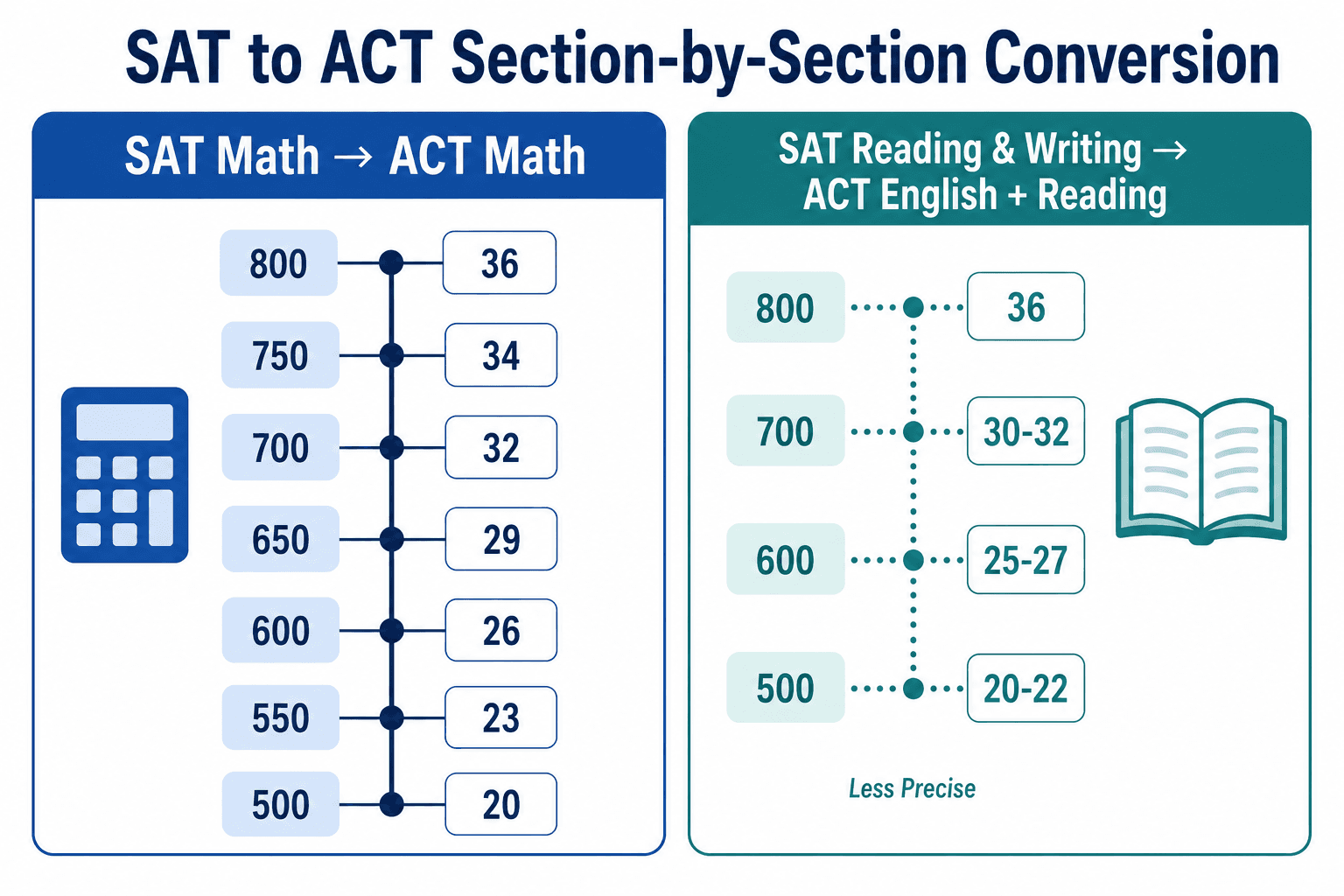
Here is how SAT sections map to ACT sections:
SAT Math → ACT Math
SAT Math Score | ACT Math Equivalent |
|---|---|
800 | 36 |
750 | 34 |
700 | 32 |
650 | 29 |
600 | 26 |
550 | 23 |
500 | 20 |
SAT Evidence-Based Reading and Writing → ACT English + Reading (Average)
The SAT's Reading and Writing (RW) section maps to a combined average of ACT English and ACT Reading scores. This conversion is less precise than Math because the two tests measure verbal skills through different formats, time pressure, and passage types.
The College Board's digital SAT assessment framework outlines why the digital SAT's section structure aligns closely enough with the 2017 concordance study to make the existing tables reliable. For students strong in Math and weaker in verbal, section-level comparison often reveals a more ACT-friendly profile than the composite suggests.
Students preparing for the Math section specifically should review our SAT Desmos calculator tips, since the digital SAT's integrated calculator tool changes how certain question types are best approached.
The Conversion Trap: Why Switching Tests Based on Score Alone Backfires
Here is something no concordance table will tell you: switching tests based on a converted score without taking a full-length practice ACT first often leads to a real score that is 2 to 4 points lower than the conversion predicted.
NAT tutors see this pattern regularly. A student converts their 1300 SAT to a 28 ACT, assumes they'd naturally score a 28, and switches. They don't. The concordance table reflects the scores of students who took both tests over time, based on a study of nearly 600,000 students. It does not predict what any single student will score on the other test without specific preparation for it.
This is what NAT calls The Conversion Trap: using a concordance number as a destination rather than a diagnostic.
The 3-Question Diagnostic
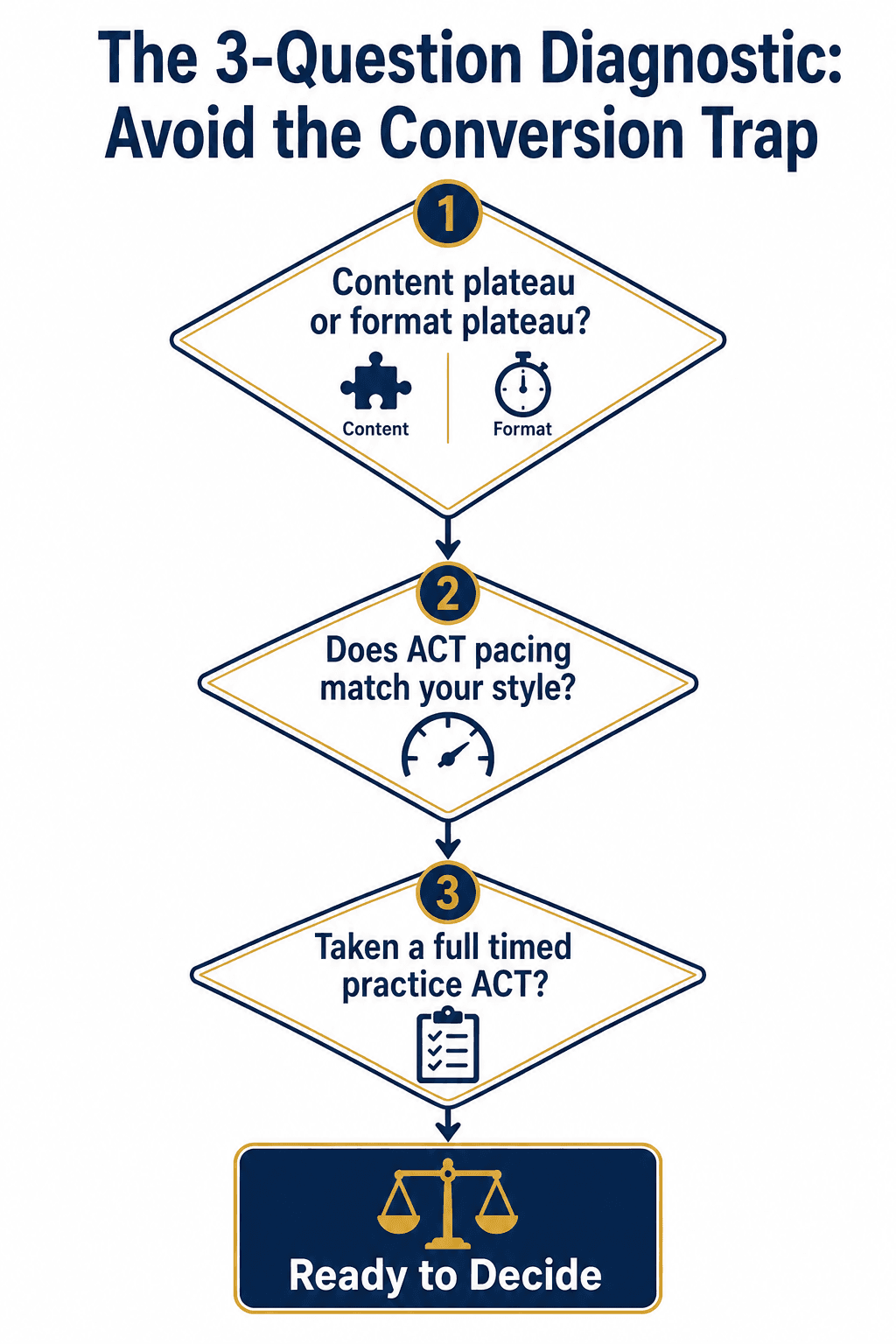
Before switching tests, answer these three questions honestly:
Did you hit a content plateau or a test-format plateau? If your scores stalled because of specific skill gaps—say, advanced algebra or reading inference—switching tests will not fix those gaps. The ACT covers the same content. A format plateau is a different problem: you run out of time, the question phrasing confuses you, or you freeze on a specific structure. That one is worth investigating.
Does the new test's structure match your natural pacing? The ACT has more questions per minute than the SAT. Students who are methodical and careful under moderate time pressure often perform better on the SAT. Fast students, confident test-takers who do well under compressed timing, often prefer the ACT.
Have you taken a full-length, timed practice ACT under real conditions? If the answer is no, you don't have enough data to make this decision. A concordance table is a starting point, not a substitute for actual test performance.
One NAT student, Avery H., improved from a 1210 SAT to a 1450 SAT after identifying that her plateau was in Reading comprehension, not test format. She considered switching to the ACT. A full-length timed practice ACT confirmed what her SAT error log had already shown: her issue was passage pacing, not test structure. Avery stayed with the SAT. That's precisely how the diagnostic is supposed to work.
For context on the ACT's current structure, including recent Science section changes, see our post on ACT Science optional changes.
Do Colleges Prefer the SAT or ACT?
Nearly all colleges and universities in the United States accept both the SAT and ACT on equal terms. There is no meaningful institutional preference for one test over the other at any major four-year institution.
Here is what actually happens in admissions offices: officers evaluate each test on its scale. A 31 ACT is reviewed as a 31 ACT, not converted to a 1400 SAT first. The College Board's score comparison guidance confirms that concordance tables exist as a tool for institutional research, not for individual admissions decision-making.
The practical takeaway: submit whichever test reflects your strongest performance. Don't submit both unless your scores are comparably strong on each.
For a deeper breakdown of which test matches different student profiles, see our full guide on SAT vs ACT: Which test is right for you.
Common Conversion Mistakes Students Make
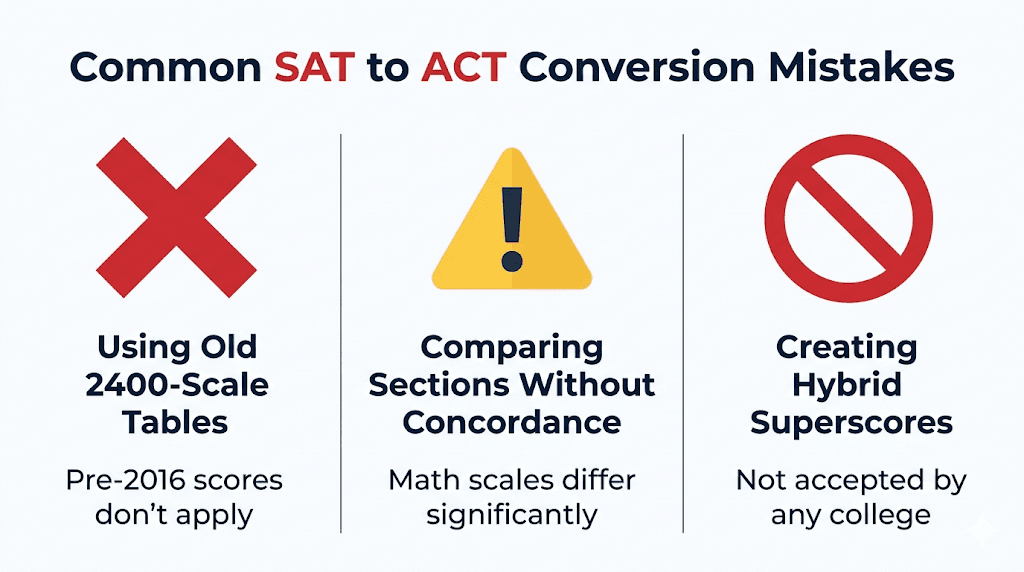
Using old SAT (2400-scale) tables for new SAT scores
The SAT changed in 2016 from a 2400-point scale to a 1600-point scale. If you find a chart listing scores like 1800, 2100, or 2400, it is outdated and does not apply to the current test. The differences between the old SAT and the digital SAT go well beyond scoring, but conversion charts are the most common source of confusion. Always verify the source and year of any table before using it.
Comparing section scores across tests without proper concordance
You cannot directly compare an SAT Math score to an ACT Math score without using a section-specific concordance. The scales are different, the timing is different, and the content weighting is different. A composite-level table cannot substitute for a section-level comparison.
Trying to create an SAT/ACT superscore
Some students attempt to combine their best SAT section scores with their best ACT section scores into a single hybrid number. This is not an accepted practice anywhere. The College Board's key considerations on score comparisons explicitly warn against creating a composite from different section scores across the two tests. No college will accept a hybrid score, and calculating one will only mislead your research.
How to Use Your Converted Score to Set a Real Target
The right use of a converted score depends on why you looked it up.
If you're converting for test selection: your next step is a full-length, timed ACT practice test under real conditions. A concordance number is a hypothesis. A practice test is data. You need data before you decide.
If you're converting for college research: use your converted score to check middle-50 score ranges at target schools. The NCES College Navigator is a free government database that shows admission statistics, including score ranges, for every accredited institution in the country. Once you know where your score sits within a school's range, our how to send SAT scores to colleges guide walks through the logistics of getting those scores to the right places.
If you're converting for scholarship research: verify which test the scholarship specifically requires or prefers. Some merit awards specify a minimum ACT composite or SAT total, and the conversion is only relevant if the scholarship explicitly accepts either test.
If you're at the lower end of the scale: don't let a low converted number discourage you. Our post on what the lowest SAT score actually means provides useful context on where the largest improvement opportunities are.
Whatever your reason for converting, the table is the starting point. Use our free SAT resources to identify where your score gaps are, or run through a full-length test from our free ACT resources if you're genuinely considering a switch.
Schedule your FREE Consultation to talk through whether the SAT or ACT is the better fit for your student. It takes 20 minutes, and there's no commitment.
Conclusion
The SAT to ACT conversion is a starting point, not a destination. A 1300 SAT equals a 28 ACT. A 1400 SAT equals a 31 ACT. A 1500 SAT equals a 34 ACT. Those numbers come from official concordance tables built on nearly 600,000 students who sat for both tests.
But the number is a clue, not a verdict. Section scores tell you more than composites when you're deciding which test to take. A practice test tells you more than a concordance table. And a diagnostic conversation with someone who understands both tests tells you more than either.
If the ACT turns out to be the better fit, our ACT tutoring specialists will help your student build on that converted number toward a real, earned score.
Your grades are now our responsibility.